
Empathy + Rage
We’re All Caught Up In An Emotional Manipulation Loop

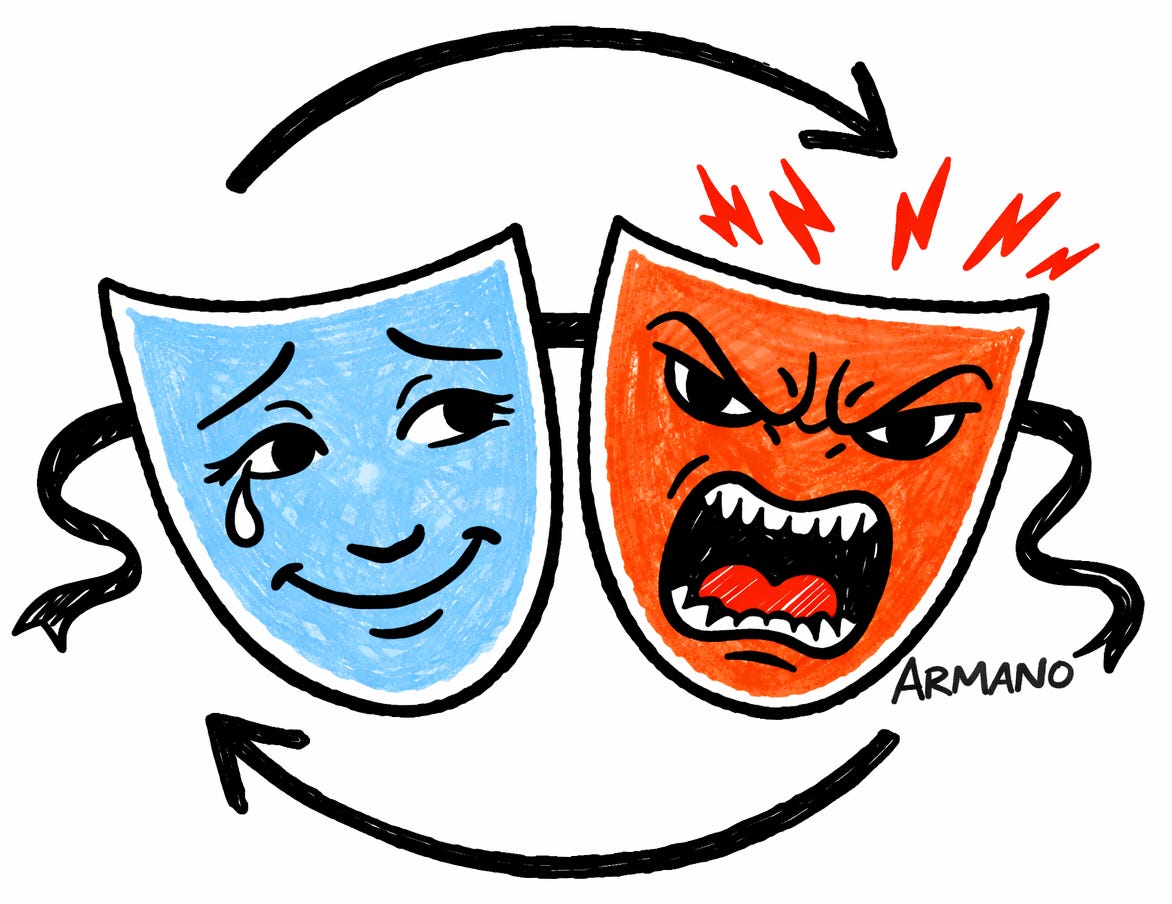
Weapons Of Mass Manipulation: The Emotional Manipulation Loop
It wasn’t long ago that I found myself having semi-regular conversations with my older son that I approached with great concern. Like many GenZers, he was floundering and felt hopeless—stuck in dead-end jobs making minimum wage and struggling. He was frustrated. He was angry. He felt hopeless. He was a perfect candidate for the weapons of mass manipulation leveraged by so many of our power brokers. We’d have many discussions, debates, and even arguments, and through it all, I stayed on one singular message, which probably made me sound like a clichéd broken-record parent.
”Take the incredible power of your emotional energy and re-focus it toward finding a vocation that will build your career and life.”
It was a process. He spent way too much of his free time consuming content that fed his outrage. The more time he spent feeding his grievances, the less time he spent investing in himself.
He was caught up in the emotional manipulation loop.
These days, thankfully, the loop's force has been minimized in his life as he has successfully re-channeled most of his formidable energy into learning the HVAC trade while building skill, experience, and his bank account. As I hoped, this particular line of work leaves very little surplus energy available to feed the industrial emotional manipulation complex that has become systemic in our culture. He spends hours doing physically punishing work and driving long hours all over the massive state of Texas. The more he works, the more his finances improve, and his future prospects brighten—all the while he starves the emotional manipulation loop.
But that’s today. The thing is, the loop is here to stay. It’s not going anywhere, and its gravitational pull is a force to be reckoned with.
Weaponized Rage
Let’s start with the reality that is generally non-controversial and universally accepted as truth. Anger, grievance, and rage are easily weaponized. I have no doubt that in Davos, at the World Economic Forum, the power brokers of the world will be discussing this topic as they have been for years, with great concern. In fact, my alma mater, Edelman, dedicated its 2025 famed Trust Barometer to the topic of “grievance”.
My son’s story is a near-perfect illustration of the risks that come with a population that feels hopeless, aggrieved, frustrated, and is easily moved toward a perpetual state of resentment and rage. There is definitely a link between populist movements (right or left) and anger, frustration, and rage directed at the system. It is these exact dynamics that not only brought Trump back to the White House for the second time but also upended the traditional Democratic machine in Manhattan, swapping a familiar Democratic liberal candidate for a nonconventional politician like Zohran Mamdani. These are the kinds of power shifts that the Edelman Trust Barometer is attempting to dissect for the elite Davos crowd, so they can better grasp what’s going on.
Rage is good for politics, good for media companies, and good for a portion of big tech. The algorithms cater to rage and serve up an endless supply of content—guaranteed to make our blood boil. We consume it, we share it. We feel better for a moment and then worse, so we rinse and repeat.
Rage is profitable and powerful.
The brilliance of today’s politicians is that they have convinced each side that it is only the other side that traffics in rage farming, but in reality, they all do it. Because it works.
Weaponized Empathy
A more controversial view is that empathy can and is also being weaponized. Unlike rage, empathy is generally viewed (with good reason) as one of humanity’s finest qualities. It is our empathy that makes us uniquely human and capable of some of the most wondrous acts of love and compassion. When we care, we take action. It was concern for his fellow Australian citizens that gave Ahmed al-Ahmed the courage to disarm, fight, and sustain injuries during the horrific terrorist attack in Bondi Beach.
It is also empathy that drives people to protect the vulnerable, or at least those they perceive as vulnerable. Empathy is a powerful emotional driver connected to a sense of justice—when we feel someone has been wronged, we empathize with them and naturally seek justice. It is our noble sense of empathy that often serves as the foundation for our sense of justice.
But much like grievance and rage can be hijacked, manipulated, and used for personal gain, so too can empathy.
Dr. Gad Saad, a Lebanese-Canadian evolutionary psychologist and a Professor of Marketing at the John Molson School of Business at Concordia University, is publishing a book in May 2026 titled “Suicidal Empathy.” The premise of the book:
How "maladaptively irrational altruism" and excessive empathy can lead to self-destructive social and political policies in Western societies.
Saad’s thesis is largely built on the idea that our well-intended sense of empathy can be turned against us or used for nefarious ends. It’s a thesis that will no doubt raise extreme discomfort and chip away at our sense of trust in society. If there are people who will take one of humanity's best qualities and use it against us, this is a bleak and troubling perspective.
But it’s not new.
Criminals, scammers, and fraudsters have, for generations, used social engineering tactics that appeal to our humanity, generosity, and empathy. There’s no shortage of victims who have parted with their money or worse becuase they thought they were helping.
Most people want to do good. Most people want to feel good. Most people are good.
Breaking Free Of The Emotional Manipulation Loop
The loop feeds on three things: unguarded attention, unprocessed emotion, and idle time. You break it the same way you’d break a bad training habit—observe it, starve it, replace it.
Observe: Name the triggers. Write them down. Platforms, personalities, topics, times of day. “I reach for X when I feel Y.” Awareness shrinks their power.
Starve: Set hard quotas for outrage inputs. Fifteen minutes, not fifty. Mute keywords. Unfollow rage merchants. Trade short-form for long-form three nights a week. If it spikes your cortisol, it doesn’t get your click.
Replace: Point that energy at craft. Something with resistance and reward. Code. Carpentry. Cooking for real people. Sweat resets the nervous system and crowds out doom loops. Cash helps too when the craft becomes a vocation.
Build a small runway. A weekly loop-breaker ritual:
One block for strenuous work or learning.
One block for service to someone local.
One block for reflection without a screen. Pen. Paper. Ten lines, not a novel.
Upgrade your share button. Before you post or forward:
Is this true?
Is it helpful?
Is it mine to say?
If two answers aren’t “yes,” don’t feed the machine.
Train the pause. Stimulus → pause → response. Breathe. Count to eight. Drink water. Then decide. The pause is where agency lives.
Design your environment: Put friction in front of junk inputs. Delete one app from your phone. Turn off push updates. Put convenience on the side of your goals, not the loop’s goals.
Pick a scoreboard that can’t be gamed: Hours learned. Reps completed. Dollars earned ethically. People helped face-to-face. These metrics are hard to fake and easy to feel.
Choose proximity over performance: Talk to a neighbor. Call your mother. Sit with a friend. The loop loses when real conversation shows up.
Mind the basics: Sleep. Sunlight. Movement. Protein. Boring beats viral.
None of this makes the loop disappear. It makes it harder to hook. The goal isn’t zen enightenment. The goal is a durable bias toward actionable agency. Attention becomes a budget. Emotion becomes fuel for building, not bait for harvesting. That’s how a person—your son, daughter, mother, father, you, me… goes from manipulated to self-directed. That’s how a culture gets a little healthier, one tight feedback loop at a time.
Empathy is good. Anger can be good when it’s righteous. Both can and are being weaponized in ways that even the most media-savvy among us (including myself) are vulnerable to. The emotional manipulation loop may be our permanent new reality, and that means it’s on us to adapt intelligently—or perpetually feed the cycle that robs us of our higher potential.
Visually yours,
David Armano is a futurist, strategist, and Enterprise AI transformation leader who helps his colleagues, clients, and community solve intricate business challenges and see a clear path forward.

He’s known for his unique approach to visual thinking and insightful, yet grounded, takes on intelligent experiences, culture, and leadership. In addition to his day job, he writes David by Design to translate complex shifts into actionable ideas.
Wow, Dave. You just wrote the recipe for reclaiming ourselves in this time of mass hijacking of our higher purpose.
The framwork of observe-starve-replace is smart, but what I've seen with my freinds stuck in the loop is that they know the triggers and still can't quit them. The real lever is that replacement step needs friction removal and immediate feedback. Like HVAC work giving visible bank account growth. Most "quit doomscrolling" advice fails becuase it offers delayed gratification against instant emotional payoff.