
Going Native
Coinbase Layoffs Reveal Business Fragility and a Flattened Future of Work

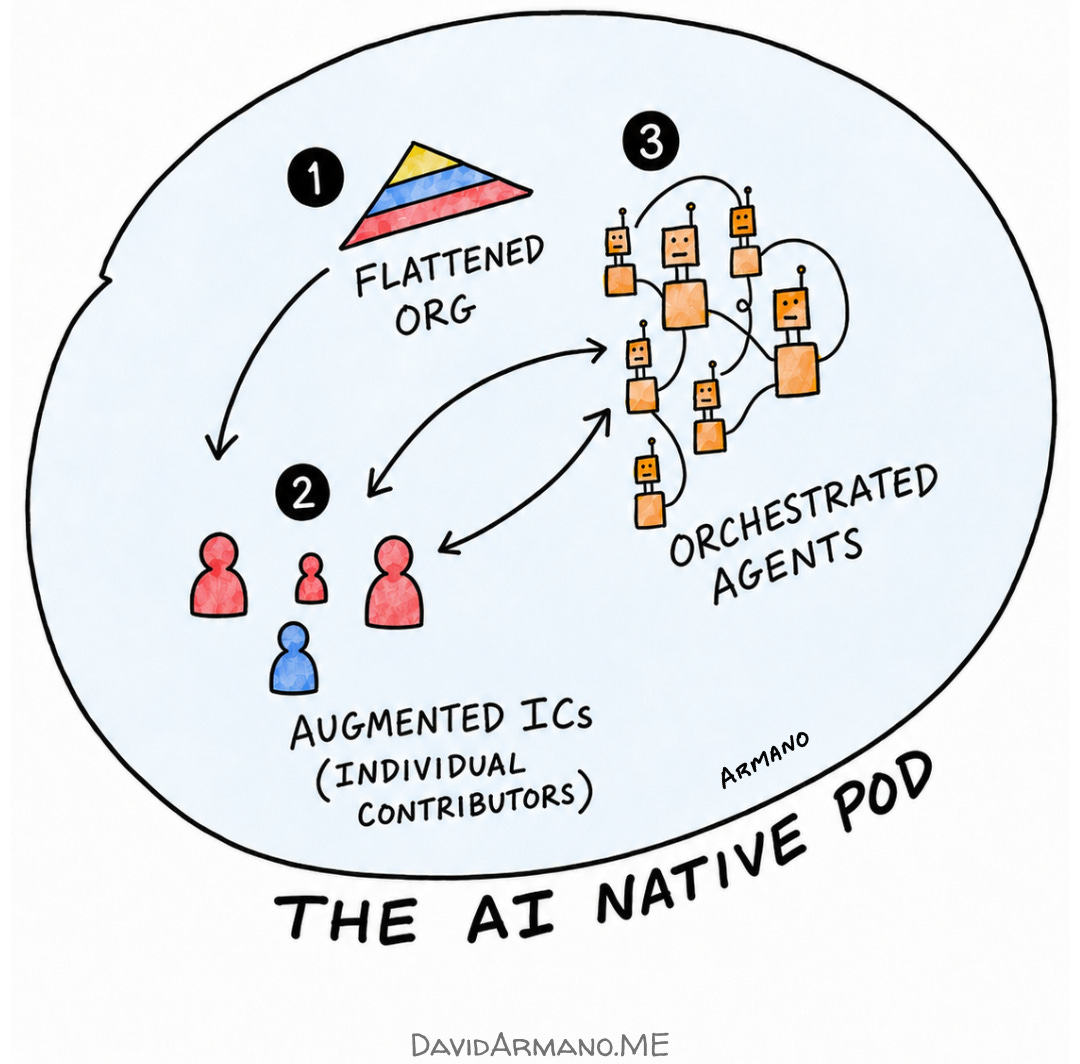
It feels like a day doesn’t go by without a company announcing a layoff and handing us the same explanation: AI is making us more efficient, so we need fewer people. Coinbase is the latest. CEO Brian Armstrong confirmed this week that roughly 700 employees—14% of the workforce—are out, as the company restructures around what he calls “AI-native pods.”
I’ve been on the receiving end of one of these announcements. In June of 2020, early-pandemic, I was one of 600-plus people let go from a job I’d held for nearly eleven years. I know what the day after that email feels like.
I’m keeping that in mind as I write this.
The Vision Is Real. So Is the Fragility.
Let’s be fair to what Armstrong is actually proposing, because some of it deserves real attention.
He wants to flatten Coinbase’s org chart to five management layers and eliminate “pure managers” in favor of player-coaches who remain active as individual contributors. Armstrong has been pushing AI adoption hard internally for a while—after securing Copilot and Cursor licenses for every engineer, he pushed for company-wide onboarding within a week, not the quarters some projected.
This isn’t a CEO who discovered AI after a bad earnings report.
But here’s the thing: Coinbase posted a $667 million net loss in Q4 2025, revenue fell 21.6% year-over-year, and the layoff announcement landed two days before the Q1 2026 earnings report. Someone deliberately chose when this news would land, and it wasn’t for the employees’ benefit.
And Coinbase isn’t alone. Every major crypto firm announcing layoffs in early 2026—Crypto.com, Block, MARA Holdings, Gemini; cited AI as the primary driver. When every company’s explanation is identical, the explanation starts to sound like a script more than a strategy.
To be clear: a real transformation and a fragile financial position can absolutely live in the same announcement. Both things are probably true here. The question worth asking is which one is actually driving the decision. “We’re restructuring for the AI era” and “we had a brutal Q4” are very different stories—even when the outcome is the same 700 people.
The Future Is Flat: The AI-Native Pod
Buried inside the layoff news is something worth paying closer attention to: the AI-native pod concept itself. In practice, some of these pods could consist of a single person directing agents that collectively handle engineering, design, and product responsibilities.
One person. Three functions. Powered by AI.
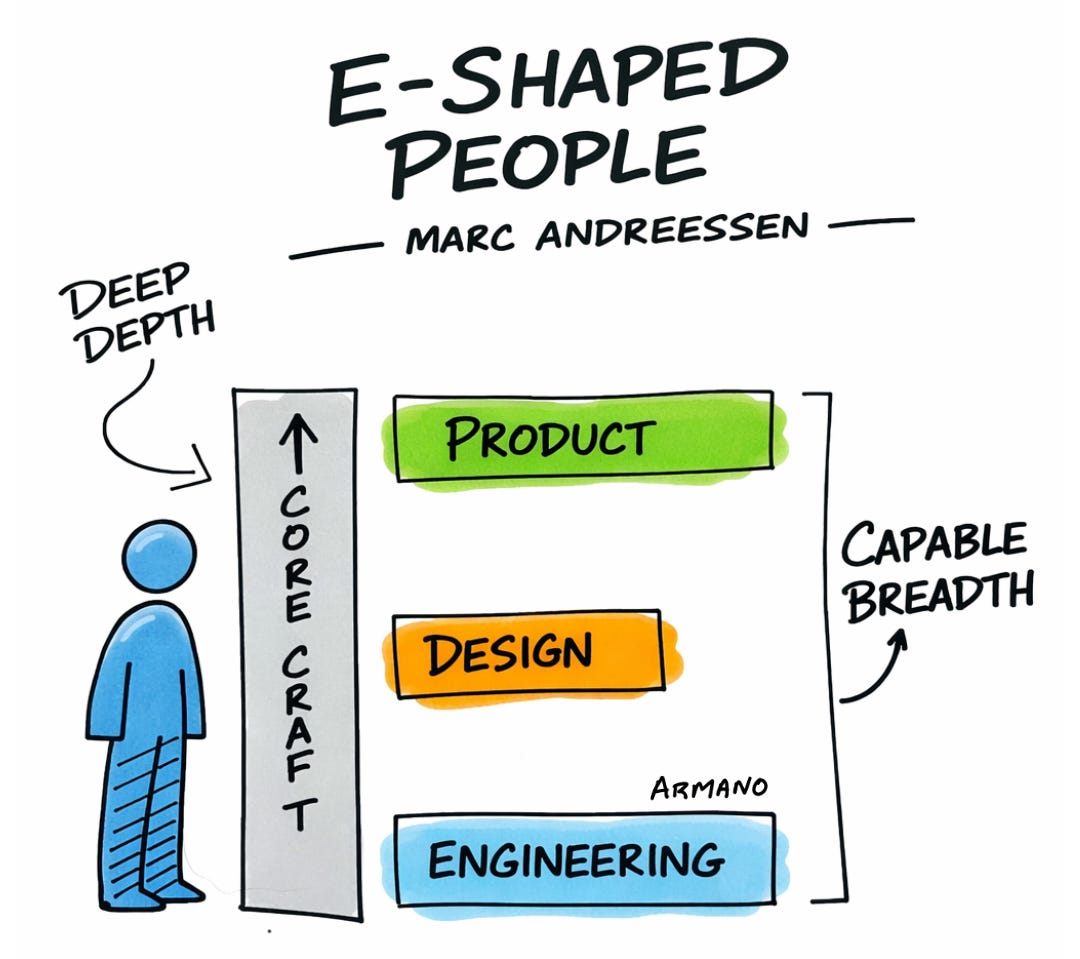
Armstrong is proposing a fundamentally different theory of how an organization should be structured—and if it works at Coinbase, others will copy it. Not because they’ve thought deeply about the human implications, but because the cost math is hard to argue with. I’ve discussed the great flattening and mentioned the concept of the E-shaped knowledge worker put forth by Marc Andreessen, and it’s no accident that these trends are emerging as a reoccurring theme in the tech industry:
The pod has three moving parts. First, a flattened org—the traditional hierarchy compresses, with fewer layers between decision-makers and the work itself. Second, augmented ICs: individual contributors who are no longer specialists doing a single job but generalists actively directing multiple workstreams. Third, orchestrated agents—a networked cluster of AI systems executing tasks in coordination, feeding output back to the human in the loop, who course-corrects and redirects. The arrows go both ways. It’s a continuous feedback loop between human judgment and AI execution, packaged as a single self-sufficient unit.
Think about what that actually requires of the person inside. They’re not just doing their job anymore. They’re orchestrating, maintaining context across workstreams, and making judgment calls that used to be distributed across a team. The accountability is concentrated. And the headcount, along with its associated cost—is reduced.
This is the part that gets glossed over in the transformation narrative. The pod model doesn’t just flatten org charts. It changes what work actually feels like, and who absorbs the complexity that used to be spread across multiple roles.
Who Actually Benefits
Whether Coinbase gets leaner isn’t really the point of the debate. It will. The more interesting question is what happens when the AI-native pod becomes the default organizational unit—not just at one crypto exchange, but across industries.
When one person directing agents replaces what used to be a three-person team, those productivity gains flow to the company and its shareholders. The worker inside the pod carries more responsibility—and in most cases, not proportionally more in return. The pod is a compelling unit of production. As a unit of human flourishing, the jury is still very much out.
So watch this one closely. Not as a crypto story, not even as an AI story. The AI-native pod is an early, high-visibility prototype of how work gets reorganized in the intelligence economy. The org charts get flatter. The press releases get optimistic. Armstrong may well be right that this is where things are heading.
The deeper question is whether the people inside those flatter organizations and AI native pods—the ones who make them actually work—will share meaningfully in the business benefits they produce.
Visually yours,
Did you enjoy what you just read? Please consider forwarding it to a friend or five.
Want more insight? The TBDaily is a human-curated, AI-automated daily briefing that provides fresh takes on what’s shaping the future of AI, Technology, Culture, Work, Health, and more. The TBDaily is trained by me to see around corners, and to help future-proofers like you stay curious, inspired, and informed. The future is TBD. Get up to speed daily.
David Armano is a futurist, strategist, and Enterprise AI transformation leader who helps his colleagues, clients, and community solve intricate business challenges and see a clear path forward.

He’s known for his unique approach to visual thinking and for insightful yet grounded takes on intelligent experiences, culture, and leadership. In addition to his day job, he writes David by Design to translate complex shifts into actionable ideas.
Dave, I'm loving this conversation, even while fearing it. On the face of it--the "Pod" model that Coinbase is subscribing to sounds very reasonable. After all, AI can automate so much execution work, we don't really need people handling it. For us Generalists who have built careers orchestrating across streams, we get to keep our jobs!
But peel this back a layer and it gets less reasonable. First let's ask ourselves: How did we Generalists get our visibility across functions? Likely because we had to hash it out in specialty roles across the spectrum, making mistakes but learning a lot along the way. Who will succeed us as the ICs in the middle? And will we be paid more for our expanded roles? Probably--especially since others were let go to pay for it. But still we have a role mobility issue.
These are the issues that keep me up at night. I'll share with you a framework I'm developing that addresses these very issues. Thanks for helping me think.
Like you, David, the timing of announcements such as this warrants a level of questioning, re. the legitimacy of the finger-pointing. Putting that aside, there are several points that these changes by Coinbase that should draw the attention and reflection of every leader.
The first is the failure to draw a distinction between intelligence and wisdom. AI is quickly commoditizing the former; it brings none of the latter. By reducing the workforce by 14%, Coinbase is significantly depleting its available wisdom.
While we continue to think of human work with time as a key metric, in fact, productivity is fueled by mental, physical, emotional, and spiritual energy. There is clear evidence already that "supervising" multiple AI agents is mentally exhausting. Creating pods of one can be compared to staffing air traffic control towers with a single person. Our wisdom is developed in community with other workers. Removing that community increases the risk of stagnation as well as burnout.
Flattening the organization is, from my perspective, a move in the right direction. It is a necessary, but may be an insufficient, move. You reference "fewer layers between decision-makers and the work itself." In most cases, the best decisions will be made by those with the most wisdom associated with that decision; that are the workers themselves, not others some number of layers above.
By its very nature, technology speeds things up. AI is certainly doing that. But speed comes with a price. It limits discussion. It leaves little if any space for innovation. It bypasses tension. It tends to ignore intuition along with wisdom. While it may be there in practice, I have seen nothing about the changes Coinbase is making that circumvent these challenges.
The pod model as described here sounds very much like a hybrid between a traditional organization and a networked one. GE Appliances is an example of an organization that has moved much more fully into the networked organization; Bayer is on the same path. While the nature of their businesses is different, the reality is the nature of their workforces is not very different. As they move forward, Coinbase may benefit from looking at these and other companies that have broken the traditional top-down, command-and-control hierarchy.
Finally, I have yet to see a substantive discussion regarding those decisions that Coinbase is keeping out of the realm of AI. This is a key element of successful AI governance in the longer-term.