
The Compression of Creative
AI Is Making Creative Output Faster, "Cheaper" and More Abundant Than Ever

As I write this, I’m looking at my degree from Pratt Institute, which proudly hangs on the wall of my home office:
David Armano
The Degree Of
Bachelor of Fine Arts (Computer Graphics) With Honors
February 1, 1995
I was awarded the degree nearly thirty-one years ago to the day. I still vividly remember the conversation I had with my mother, whom I woke up in the middle of the night after coming back from my part-time job at a bar. I had informed her that I knew what I wanted to do with my life, and, having been notified that I was accepted into Pratt, I wanted to pursue a career combining design and technology. My mother’s words:
”If that’s your decision, we’ll support it.”
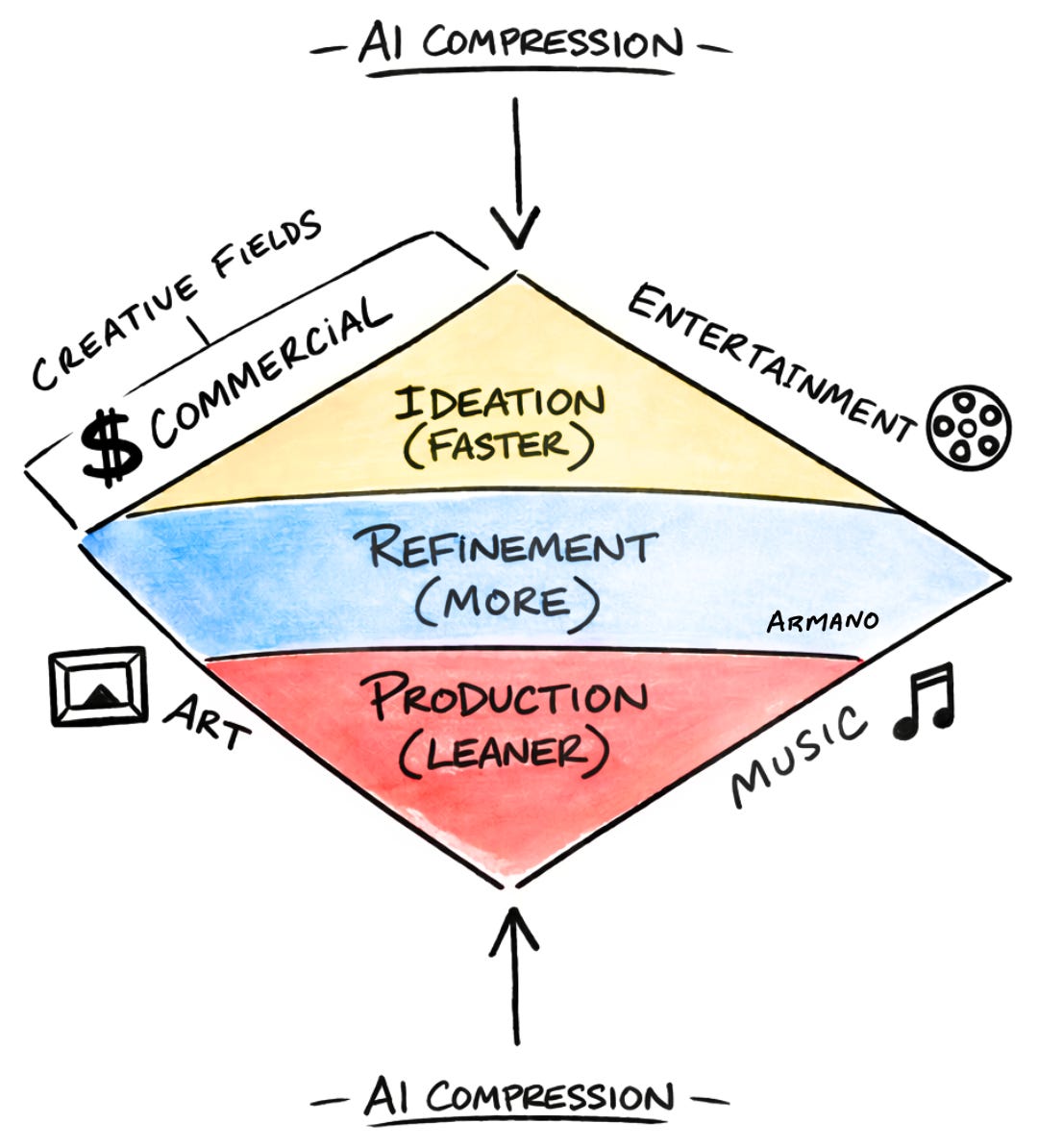
Long story short—I succeeded, way beyond what I had envisioned in those formative years. Now, I imagine if one of my sons came to me at the same age in the middle of the night and expressed a desire to get into one of the creative fields (I had chosen “commercial” via the diagram above—a broad category where many creative professionals work either full time ot freelance across numerous fields from writing to design to marketing, consulting etc.)… I think I’d be as supportive as my mother ultimately was, BUT I’d have a long discussion about the state of the industry they were choosing, and it’s a state more compressed than it ever has been before, and we can thank, or curse AI, for this. In the not-so-distant future, there will be both thanking and cursing alike.
The Winners of Compressing Creative
First, let’s look at a portrait of some of the folks who are going to benefit from the opportunities that a compression of creative will unlock. I’ve been following the journey of an aquianence for a few years now, who has been transitioning from a highly successful career in technology to the more muddled years of semi-retirement. I’ve watched as this individual first discovered a love for playing guitar, then began using multiple AI platforms not only to create her newly found art form in music, but also to curate her image as a musician. After a few years of putting her time, energy, and art into her AI-enhanced artistry, she’s developed a small following in Eastern Europe and is no doubt reaching audiences she would never have reached before. If it weren’t for Generative AI, which plays a role in her songwriting, production, and persona.
The sense of purpose that all of this has brought to her life is palpable. There will be thousands like her and maybe millions. As I often point out, AI is going to create winners and losers, and retirees who have already built their nest eggs and are seeking purpose and meaning in their late career years stand to be winners. So too will be numerous individuals who combine AI know-how with media savvy.
But there are going to be losers as well
The Disruption
Going back to my experience at Pratt, that period in history marked the birth of CGI (Computer-Generated Imagery). Given that my area of study was Computer Graphics, I spent countless hours in a computer lab working on assignments while SIGGRAPH posters hung on the walls.
I learned the basics of 3-D rendering and animation in addition to the foundational design classes. It was all so new and emerging. While I chose to start my career as a visual designer, post graduation, I watched as the field of CGI matured and became synonymous with special effects in Hollywood. Prior to CGI in entertainment, we used things like animatronics and physical sets. That’s all CGI now, and it's been that way for a very long time.
This is all going to change much faster than when CGI began taking over, when I witnessed its birth. If anyone remembers the “Luxo Jr” animation short, which eventually became the foundation for Pixar, which then rolled up under Disney, we’re at that moment with AI video (this is China’s Seedance model).
But it won’t take decades—more like a few years. Take a look at the animation below, generated entirely with AI:
My guess is that the way we critique CGI now (oh, that’s terrible CGI or, wow—the CGI was really great!)… is how we will start talking about AI in modern entertainment. CGI, as we once knew it, is going to change dramatically in a relatively short amount of time. The arrows in the above visual labeled “AI Compression are the point. They’re squeezing time, cost, and effort across the whole system. That’s both the gift and the threat.
On the upside, it expands who gets to participate. People who once sat outside the gates can now make things, publish things, and even build audiences. On the downside, the middle gets crowded. When output gets easy, distinction gets harder. When everyone can produce, the work shifts toward taste, point of view, and craft you can’t download. Which is why the CGI analogy matters. We learned to live with “good CGI” and “bad CGI.” We’ll do the same with AI-created entertainment. The difference is speed.
In the entertainment industry, the disruption these days feels existential, especially to actors. See Matthew McConaughey’s POV on what entertainers should be doing now to protect and own their likeness:
McConaughey’s “trademark your likeness now” comment is less celebrity panic and more a signal that entertainment is sliding into a new operating mode: identity as an asset class. When it becomes cheap to synthesize a voice, face, cadence, even a whole “performance,” the scarce thing isn’t content—it’s permission. Trademarks won’t solve the whole problem (copyright, contracts, and state right-of-publicity laws still matter), but they do create leverage: a clearer perimeter around what can be used, by whom, and under what terms. The larger point is uncomfortable: entertainment is drifting from “capturing” humans to “compiling” them. In that world, actors who lock down name/image/likeness early have negotiating power; actors who don’t risk waking up to a market where their digital twin is already doing day-rates without them.
In the marketing world, it’s not uncommon to hear leaders talk about how they can now explore the possibilities of sixty ideas instead of six before narrowing down what the winning idea actually ends up being. The thing many commercial creatives sometimes overlook is the “commercial” part—and how much of the commercial creative field is driven by business realities, including scale, price, and the economics of efficiency.
AI compression makes this tension sharper than ever—and creative talent on the production front lines are likely to feel it first and hardest.
Diamonds Are Forever. Creative Industries Are Forever Changed…
A friend of mine, a creative director, was recently laid off. Like many in this predicament, they have been struggling to re-enter the job market as a FTE. I’ve recently contracted this person to work on a personal video project for me, and when it came to the point of choosing a music soundtrack, they presented some choices of royalty-free music that I knew were not close to what I was looking for, nor did I want to go through the process of finding the perfect royalty-free track. Instead, I made one myself on Suno, and it took about 10 minutes to find the sound I was looking for. These two real-world examples illustrate the effects of the compression of creativity: a tighter job market for traditional employment, and yet more possibilities for creative output at the same time.
The creative compression diamond is something of a paradox.
It’s not by accident that I chose a diamond shape to illustrate the “compression of creative”. Diamonds don’t become diamonds by “optimizing.” They become diamonds under brutal, sustained pressure over time. Now scientists can mimic that pressure in a lab and produce diamonds that look the part, measure the part, and cost a fraction of what nature charges for the originals. The outcome is strange and familiar: diamonds are more accessible than they’ve ever been, yet the cultural gravity of the natural stone feels lighter than it used to.
That’s compressing creative in a nutshell. AI is the lab press. It’s taking processes that once required years of apprenticeship and squeezing them into hours, lowering the cost of “making” across ideation, refinement, and production. The upside is obvious—more people get to create, ship, and find an audience. The harder truth is that the flood changes what we value. When the diamond becomes easy to manufacture, rarity migrates. It moves from the object to the origin story. From Polish to pervasiveness and from scarcity to abundance.
In the next era, the “natural diamond” might not be the most technically perfect work—it might be the one that still carries human risk, taste, and consequence. But if you’re a creative, don’t make the mistake of mixing the business of creating commercial output with art. AI is conspiring with the business world to build a new machine with new rules that are impossible to ignore. The future of creative fields is TBD, but it’s probably going to become more compressed than we’ve ever seen it.
Visually yours,
David Armano is a futurist, strategist, and Enterprise AI transformation leader who helps his colleagues, clients, and community solve intricate business challenges and see a clear path forward.

He’s known for his unique approach to visual thinking and insightful, yet grounded, takes on intelligent experiences, culture, and leadership. In addition to his day job, he writes David by Design to translate complex shifts into actionable ideas.
Great piece, David. I'll confess... I'm more excited about this than worried. For years, the craft of execution gatekept who got to have creative ideas taken seriously. If you couldn't design it or produce it yourself, your idea stayed on a whiteboard or less. Now the barrier between "I have an idea" and "here's what it looks like" is basically gone. That's not a loss as far as I am concerned...it's a long overdue leveling of the playing field. The compression you're describing is also expanding who gets to be creative.
Commoditization on the low end and bespoke pricing on the high end.