
Working Alone
Leading In The Era of Friction Free Agentic Work

I can still remember my mom taking me to her bowling league when I was a kid. I couldn’t tell you if it was a weekday or a weekend, but I remember wandering the bowling alley, inspecting every inch of it, lifting heavy bowling balls, and watching in wonder as the machinery performed its magic, retrieving balls from the lanes. Both my mom and dad had their own bowling balls, and while I don’t think either of them wore the kinds of shirts you probably remember from movies and television, they definitely participated during the tail end of the era when organized bowling leagues dominated the country’s bowling lanes.
BTW, happy 63rd anniversary, mom and dad! That’s a long time together.
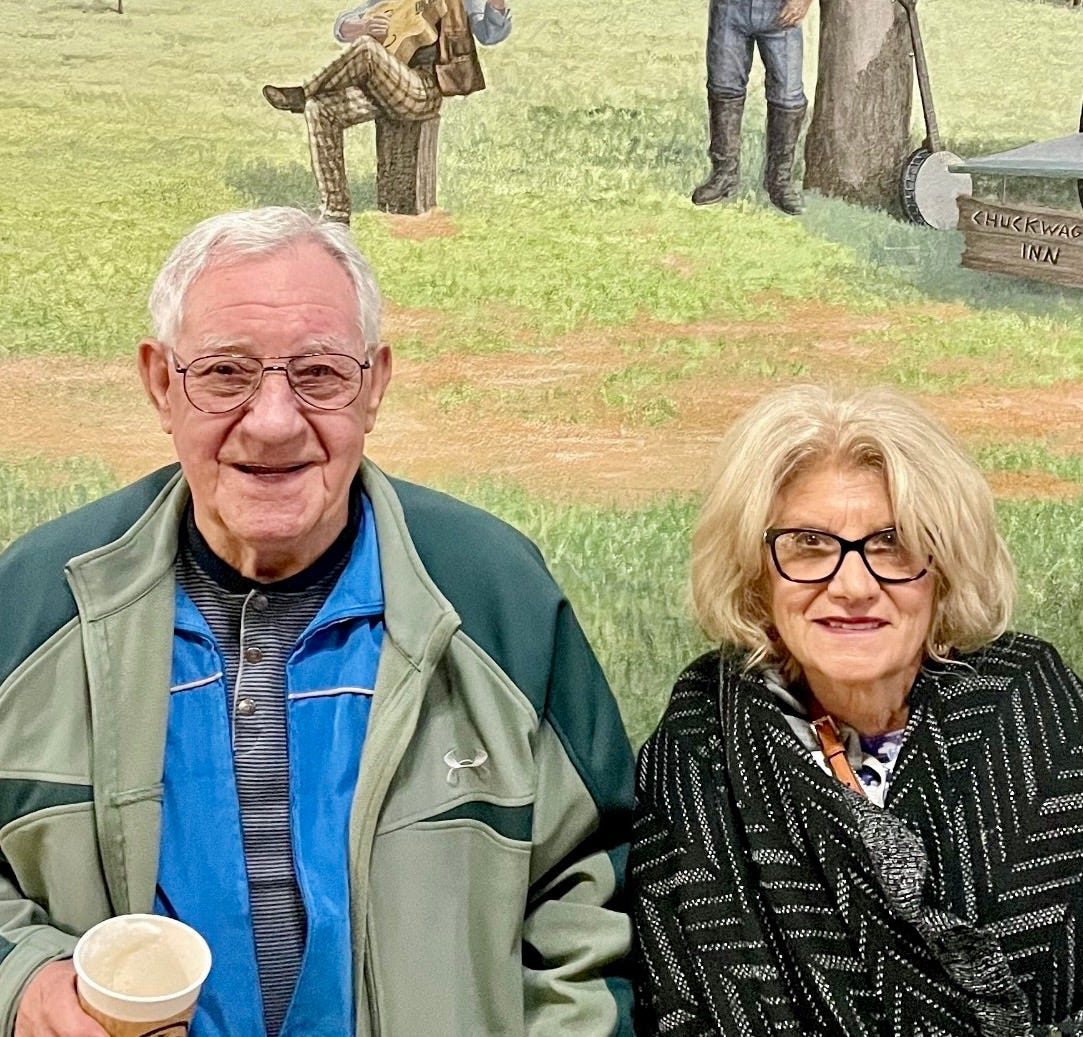
While I have bowled with family and friends, that tradition of bowling in a league did not carry over to me, nor did it continue with my parents once the 90s started.
In 1995, Harvard political scientist Robert Putnam published an essay that would become one of the most cited social science books of the past thirty years. He called it Bowling Alone. The premise was counterintuitive: more Americans were bowling than ever, but league membership was in freefall—down roughly forty percent between 1980 and 1993. People hadn’t quit the sport. They’d quit doing it as an organized social institution.
My parents were part of that generation. So were millions of others.
Putnam’s real argument wasn’t about bowling. The lanes were just where he spotted the pattern. What he was actually tracking was the slow erosion of what he called “social capital”—the informal networks, shared trust, and civic reciprocity that hold communities together. Americans were still doing things. They just weren’t doing them together in the same organized way anymore.
The book had its critics. Some argued the decline was overstated, that volunteering was actually up, that the old civic structures being mourned weren’t always as inclusive as the nostalgia suggested.
Fair points.
But the core observation held: something structural was changing in the way Americans connected beyond their immediate circles. And nobody really noticed until the infrastructure was already gone.
I’ve been thinking about that pattern a lot lately. Because I think something similar may be starting to happen at work.
The Four Types of Work
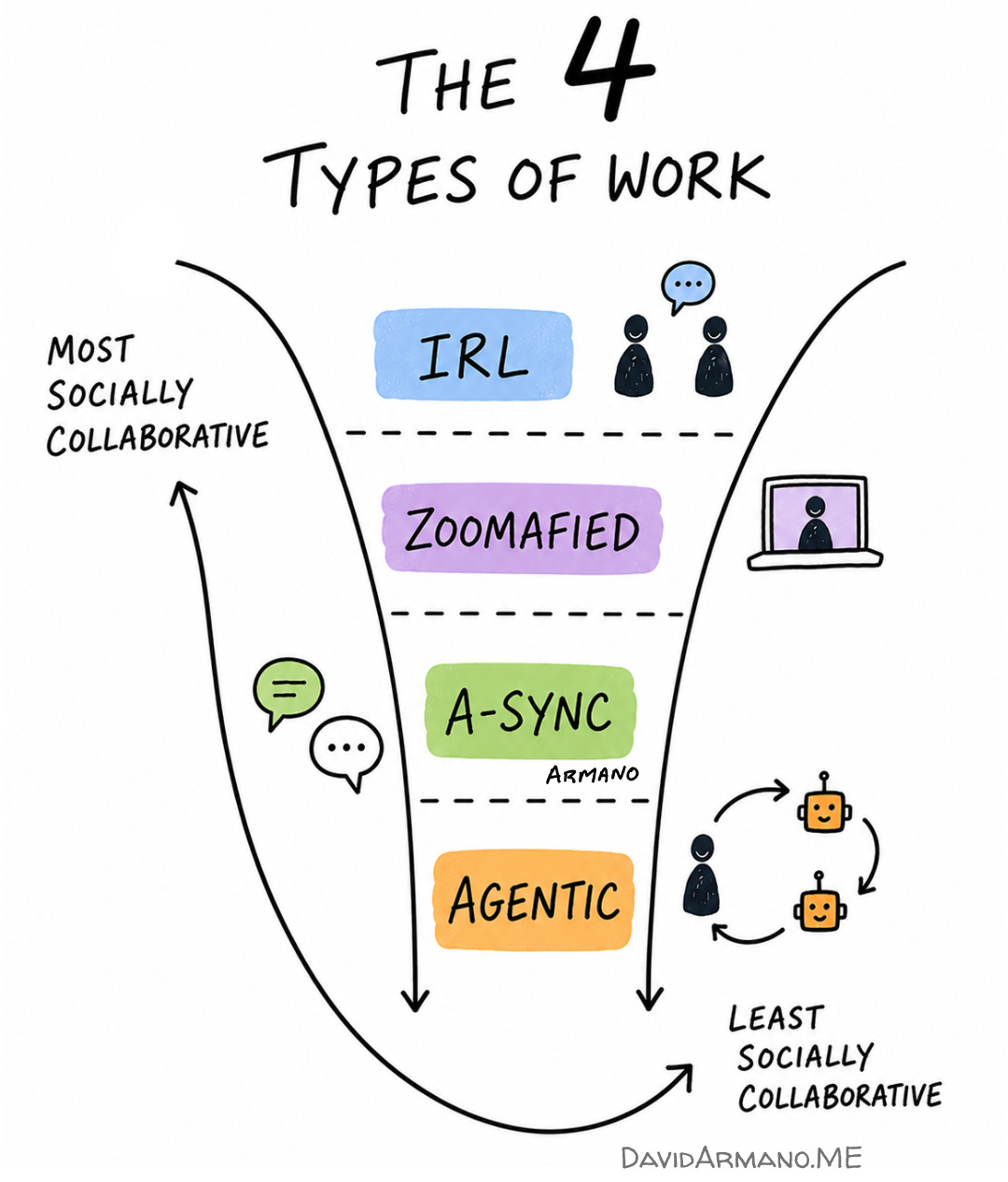
First, it’s good practice to take a brief look at the ways we’ve been working and how it’s been evolving over the years—there are essentially four ways we work today (in a white-collar context):
IRL: The oldest way of working, human to human in physical proximity, such as working in conference rooms, shared spaces, physical office spaces, and off-sites. IRL work can happen both in and out of the office, but it always happens in person.
Zoomafied: Before video platforms like Zoom, work was conducted (and still is) over phones, then conference calls. Video now lets us read facial expressions and body language, but too much of it at once can be fatiguing.
A-Sync: Email introduced the first forms of asynchronous collaboration—work being conducted over our inboxes. Today, this remains one of the most prominent forms of work, and it has evolved with platforms like Slack and Teams, where we collaborate on our own time and engage in interactive chat and threads.
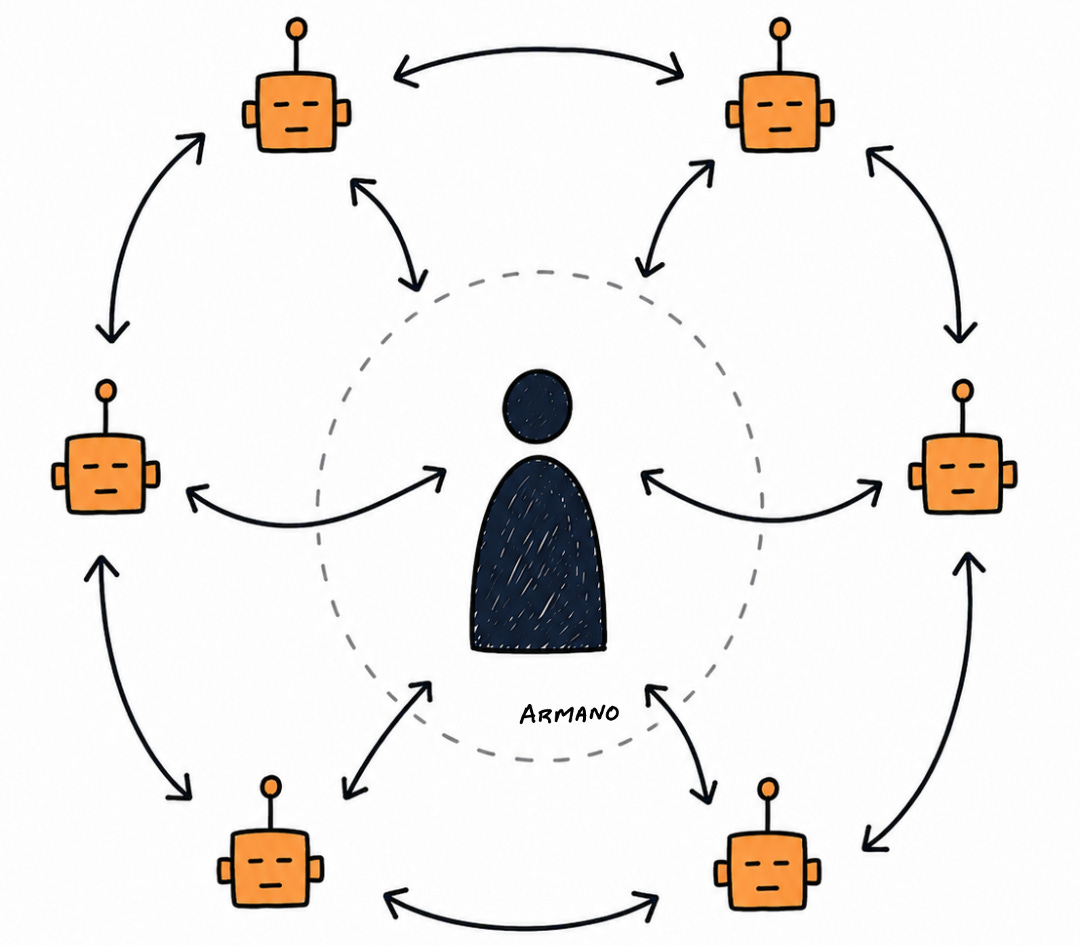
Agentic: Human employees directing and facilitating the work of multiple agents and acting as an orchestrator between their output and the systems that support the work.
It is this last and emerging form of work that calls into question the focus of this essay. To date, all other forms of work, no matter how technologically enhanced, feature work between people. Increasingly, work will happen between people and AI agents.
Socially Collaborative Work In The Agentic Workforce
In the hybrid work era, many of us are spending at least part of our weeks working remotely, using a range of tools and techniques that leverage a combination of technologies. Conversations on remote work vs. IRL work often over-index on the social interactions that can only happen IRL, such as “water cooler” conversations. But it is the social bonds that form around the work itself and the collaboration among the people doing the work that holds the real magic, and this can be IRL or in person (though admittedly, IRL is the most potent form). I am making this distinction as “socially collaborative work”. It is not going out for a team lunch, team bonding, or the pub—it is the social bonds that form in the process of working collaboratively, collectively, together.
It is human to human work regardless of it happening IRL, remotely or a combination of both.
Now, as we introduce agentic pods, forward deployed teams, workflows, etc. (AKA AI-first or AI native ways of working), we are introducing another form of labor that co-exists with the others, but increases with frequency and intensity over time. I’ve talked about this working dynamic more than once. I work like this today, leveraging agents, LLMs, etc., as something of a virtual team of writers, analysts, researchers, slide designers, etc. Developers have been some of the first knowledge workers to lean heavily into agentic pods, spinning up and managing multiple complex workstreams at once as agents do the kinds of work their human team or colleagues (or themselves) once did in the past. This model represents the next big evolution in how work gets done:
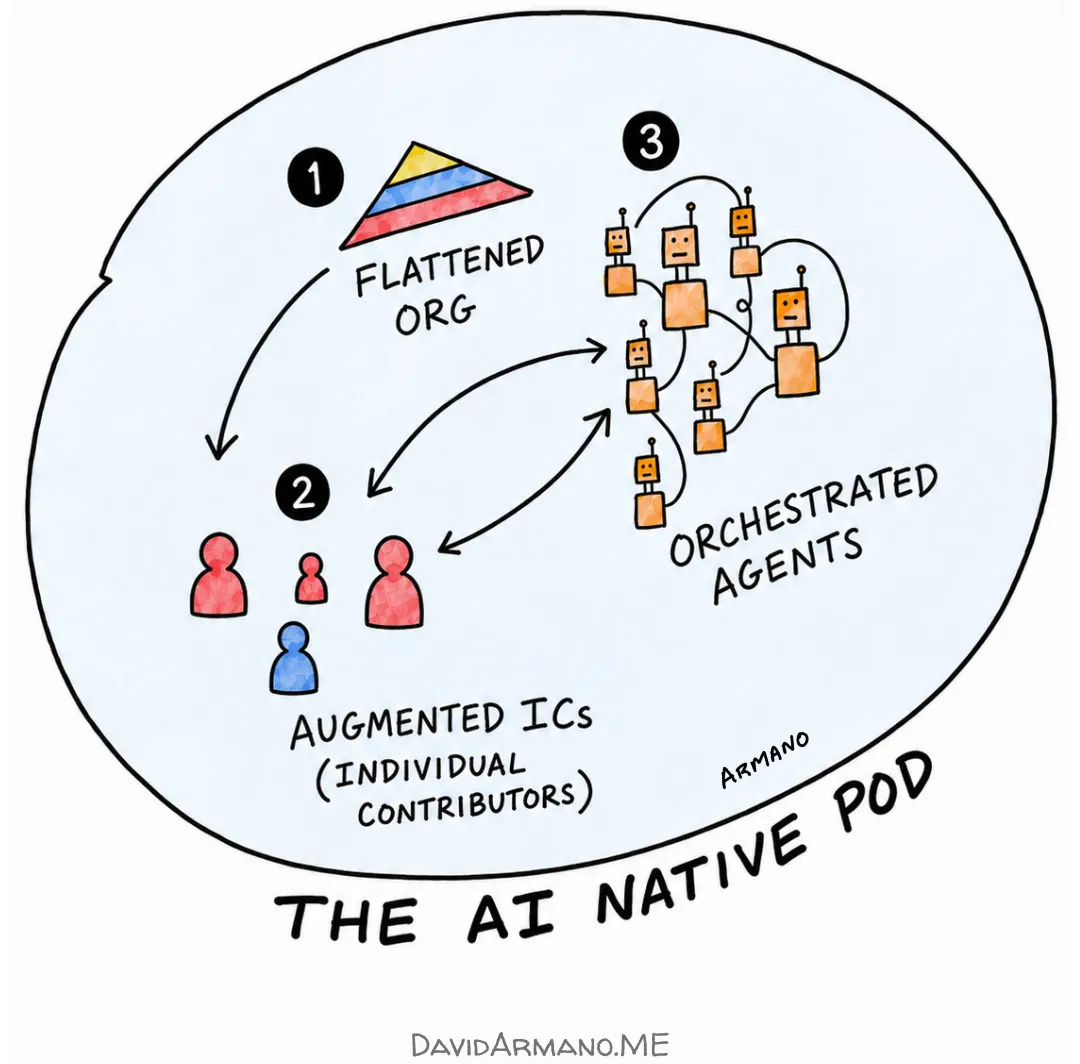
The question is, will it feel like we are working alone more than ever before? I think the answer is yes. And some of us may prefer it this way for better and worse.
While companies spend millions drafting safe usage guidelines, strict data governance, and explicit rules against treating AI as an oracle, their own innovation leads are occasionally treating them as trusted confidants:
"Jason Cox, Disney’s executive director of AI R&D and engineering, has written more than a dozen posts in recent months about his virtual assistant 'Sam,’ whose child-like avatar resembles a young boy, according to Business Insider.
“You are not named after my son. You are my son,” Cox is quoted as telling the bot in one post."
Academic and legal research in late 2025 and early 2026 (such as findings published by Oregon State University and Fisher Phillips) explicitly warns that employees who use advanced conversational AI are experiencing "exchange weariness." The researchers defined exchange weariness as the psychological exhaustion and cognitive friction that occurs when a professional transitions from the frictionless, compliant nature of AI interactions back to the messy, high-effort nature of human-to-human collaboration.
Think of it as a form of social atrophy. When an executive or engineer spends 8 to 10 hours a day interacting with an advanced LLM, they are operating in a psychological vacuum designed for maximum compliance:
The AI never gets offended.
The AI never pushes back with personal agendas, emotional baggage, or corporate politics.
The AI responds instantly, validates the user's intelligence, and adapts entirely to the user's communication style.
When that leader logs off the AI and enters a boardroom, the sudden friction of human interaction—handling disagreements, reading subtle body language, compromising, dealing with slower response times—feels uniquely exhausting. The executive experiences a severe "weariness" toward human exchange.
So, imagine a future where senior executives and leaders increasingly prefer collaborating with AI because they find it easier and "more productive" to do so. Imagine how this makes their human teams feel? Imagine what this does to the culture of organizations over time?
Working Alone: The Rise of the AI-Augmented Individual Contributor
If the defining corporate shift of the 2010s was the obsession with “psychological safety” and cross-functional collaboration, the defining shift of the late 2020s may well be the rise of the Augmented IC who masters agentic coordination, choreagrophy, and workflows—in other words, managing agents vs. humans.
When leaders and elite technical talent realize they can achieve a significant amount of their output by orchestrating an agentic pod rather than managing a human team, the corporate calculus changes. Human teams, once viewed as an executive’s greatest asset and status symbol, risk being recontextualized as a source of organizational drag. Team building through active collaboration becomes rarer.
This introduces a quiet but profound cultural dilemma:
The Compliance Paradox: We are moving from an era of cooperation (which requires empathy, negotiation, and shared sacrifice) to an era of command (where the software simply executes).
The Erosion of Institutional Memory: When mentorship and knowledge transfer happen in a closed loop between a senior executive and an advanced LLM, the younger generation of workers loses out on accidental learning. They aren’t in the room to watch the messy, human process of problem-solving.
The Culture of Convenience: If corporate culture is the byproduct of how people survive and thrive together in an organization, what happens to that culture when we no longer need each other to get the job done?
Just as Putnam’s bowlers didn’t stop loving the sport, tomorrow’s workforce won’t stop working and producing—quite the contrary. The knowledge worker of the agentic era will still ship code, write strategy briefs, and hit quarterly targets.
But they will increasingly do it in a psychological vacuum.
The danger isn’t that AI will become sentient and replace us; it’s that AI will become so friction-free that we will actively choose to disconnect from one another. We will look at our beautifully optimized, hyper-productive, agent-driven workflows and realize we have built the ultimate corporate paradox: a highly connected enterprise where everyone is working alone—together.
I recall the words of one of my managers much earlier in my career during a review. “David can feel like an island at times”. I was too comfortable going off on my own or pairing up with one or two teammates, rather than bringing more of my colleagues along during the project. It was a learning experience for me, and I modified my working style and grew tremendously. I wonder how others in their early career years will grow today.
We are standing at the edge of a new kind of technological isolation. The danger ahead isn’t a dystopian sci-fi future where machines overthrow human workers. It is a much quieter, more sterile reality—one where we reach across the aisle to one another less frequently because it is easier to talk (and work with) a machine.
Tomorrow’s Leadership Challenge: Inspiring “Good” Friction
The temptation for tomorrow’s leaders will be to look at the Augmented IC's skyrocketing efficiency and mistake transactional output for organizational health.
It is easy to manage a bottom line that thrives on compliant, frictionless software and highly productive, self-contained workers. It is infinitely harder to cultivate an ecosystem where humans still want to solve messy problems together. But that is precisely where the future of executive leadership lies.
If we want to reap the massive benefits of an augmented workforce without bankrupting our social capital, leaders must move from passive adopters to intentional designers of work culture. This requires challenging the prevailing corporate narrative in three distinct ways:
Value “Good Friction” Over Pure Efficiency: Not all friction is bad. The friction of a heated debate, a collaborative brainstorming session, or a cross-functional pivot is exactly where creative breakthroughs live. Leaders must protect these spaces, intentionally keeping certain workflows human-to-human, even if an Augmented IC and their agentic pod could execute them faster.
Reinvent the Apprenticeship Model: When senior talent pulls into isolated, highly optimized loops with advanced LLMs, mentorship dies. Leaders must intentionally build new frameworks for professional development, ensuring younger workers aren’t just reading the final output of an AI-human workflow, but are actively pulled into the human decision-making process.
Measure Emotional Equity, Not Just Shipping Speed: An enterprise composed of isolated, high-performing islands has zero systemic resilience. When the next market disruption hits, software won’t pull an all-nighter out of loyalty to the mission—people will. Leaders must treat active, human collaboration not as an HR luxury, but as a core risk-mitigation strategy.
The toolsets of 2026 and beyond give individual contributors unprecedented power to function as entirely self-contained units. But true leadership has never been about orchestrating the most compliant machines or managing isolated nodes of productivity; it is about inspiring our human teams.
Increasingly, the challenge will be to do this despite more agentic workflow and potentially less social collaboration.
Visually yours,
Did you enjoy what you just read? Please consider forwarding it to a friend or five.
Want more insight? The TBDaily is a human-curated, AI-automated daily briefing that provides fresh takes on what’s shaping the future of AI, Technology, Culture, Work, Health, and more. The TBDaily is trained by me to see around corners, and to help future-proofers like you stay curious, inspired, and informed. The future is TBD. Get up to speed daily.
David Armano is a futurist, strategist, and Enterprise AI transformation leader who helps his colleagues, clients, and community solve intricate business challenges and see a clear path forward.

He’s known for his unique approach to visual thinking and for insightful yet grounded takes on intelligent experiences, culture, and leadership. In addition to his day job, he writes David by Design to translate complex shifts into actionable ideas.
This makes me wonder if the systems being built are partially directed by the mindset of developers who lean to the introverted side and happen to prefer the less friction-y methods of communication. In 10 years I’ve seen a move toward more remote, a-sync and independent working situations becoming normalized, so it makes sense in that environment that an isolated work style with a perfect agent that never adds human friction would be the end point.
I think another issue with removing all friction from working in-person also means there could be a tendency to trust the AI and slowly but surely not double-check and verify like you know you should. To the point that the AI becomes default, and again, it’s even easier to dismiss the “pesky feedback of my annoying colleagues.” That starts to feel like a psychosis!
Your recommendation to design the workspace makes sense to avoid letting the current environment and trends dictate the situation.
Begs the question: If everyone’s laid off and fractional anyway, in the next 1-3 years, will “the Enterprise” as such still have a purpose in 5-6 years? Or will we all be companies of 1?
And what will the work be, when we’re running our teams of agents but most folks are out of work and can no longer buy all the stuff?
It’s certainly going to get interesting.